I crossed the border between Russia and Belarus at a tumultuous time in the late 1990s. I had a lot to worry about—and to be excited about. I’m amazed at how, so many years later, what stands out in my memory isn’t the dramatic backdrop. It’s an ordinary moment with a student whose name I don’t remember, but whose compassion I will never forget.
As a visiting American university lecturer, I was based in Russia for two years. An American friend had invited me to spend the weekend in neighboring Belarus. She was hosting a conference where I would be a guest speaker. I was always excited to see a new place, and I was so passionate to teach on environmental topics anywhere I was invited.
I was struggling with Russian visa issues—nothing I had done wrong, just an unfortunately common mix-up on paperwork. The train journey to and from Belarus would provide a chance to get a new exit/entry visa that would clear up all my problems. Or so I thought.
Little did I know, the tension between Russia and Belarus had escalated to the point where the border was suddenly “removed.” The train didn’t stop at the border. I had no chance to get a new visa.
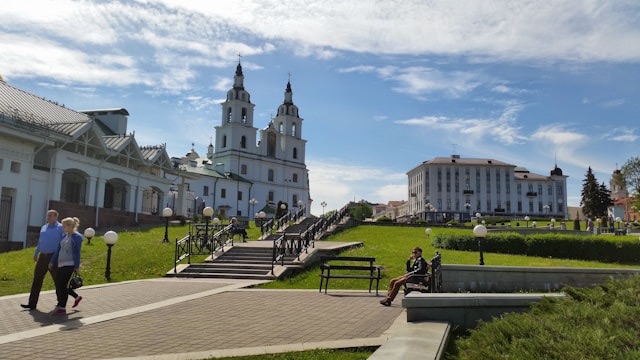
While the border confusion might have inconvenienced me, the tension affected a whole nation far worse. Belarus’s leader canceled elections. The value of their currency plummeted the day I arrived. Locals were faced with so many unknowns, and the tension was visible.
My friend who had invited me was married to an American diplomat, who met me at the train station in Minsk. He just shook his head by way of explanation, and we went to McDonald’s for a burger. He expressed sympathy over my Russian visa situation, but there was nothing he could have done.
I was to speak that evening, and again the next day, as part of the weekend conference. Meanwhile, I had a few hours with nothing to do. A student from the university in Minsk had been assigned to help with whatever I needed. She was willing to take me on any official errand or to any of the famous tourist sites in the city.
After a moment’s thought, I said with a laugh, “What I’d really like to do is buy some eye liner.” I also asked where I could find a CD of my favorite Russian pop singer.
She smiled. “I know where we can go.”

We spent the afternoon at a shopping mall, looking for makeup and CDs. This was an old-style, Soviet-era shopping mall—not what comes to mind when you think of a shopping mall today. The arrival of Western items was still fairly new. But this student knew where to find the items I was looking for. We could barely communicate, but we had so much fun. The search for makeup and music doesn’t require translation to be enjoyed together.
I’ve never forgotten that day. It stands out as one of my favorite moments living overseas. Forgotten were all the politics, border patrols, visa problems, and even the excitement of presenting my work at the conference. We were just two kids having fun at a shopping mall. An ordinary moment that brought such familiarity and peace in an otherwise tumultuous world. I am thankful for that student spending the afternoon with me.
When you travel or live abroad, these are the moments not to miss. They are the memories that will last far longer than the bigger dramas. Be fully present in those ordinary moments. Enjoy the company of the people who cross your path. Then write about those experiences as an encouragement to others.
Have you encountered an ordinary moment in an extraordinary situation? I’d love to hear about it.
Be blessed!
 Exploring Generations